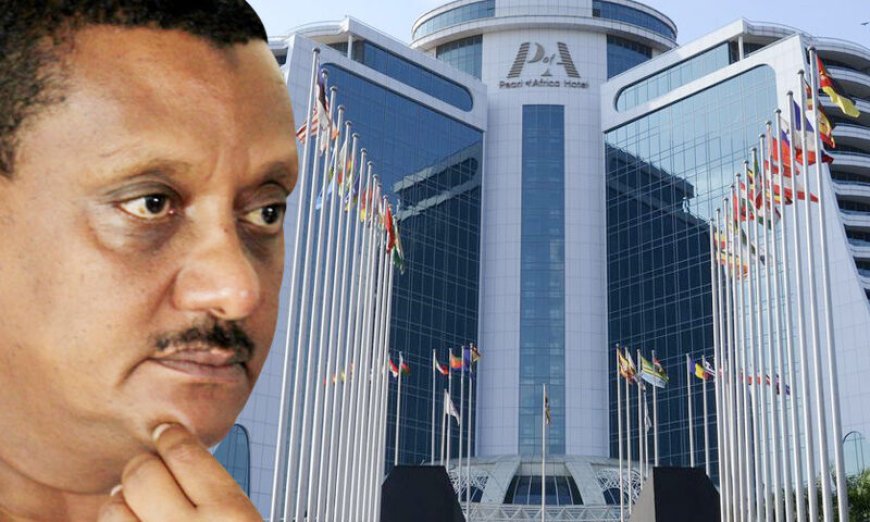
SPECIAL REPORT: Inside the Fall of AYA Group—How Uganda's Hospitality Boom Left Mohammed Hamid Behind
Mohammed Hamid, Executive Chairman of the AYA Group, has effectively lost physical and operational control of the iconic Pearl of Africa Hotel on Nakasero Hill. Despite national tourism revenue milestones, an unprecedented boom in Uganda's business tourism, and direct interventions from President Yoweri Museveni, a staggering $167 million USD (approx. UGX 647.9 billion) debt has fractured Hamid's hospitality empire. What was built to be the crown jewel of Kampala’s skyline has transitioned from a story of private-sector ambition into a cautionary tale of crippling financial defaults, procedural blunders, and sovereign takeover. Uganda’s strategic positioning as a regional hub for international conferences and corporate gatherings has triggered an unprecedented hospitality boom. Yet, while the broader market expanded, AYA Group failed to thrive. The stark contrast between sector opportunities and AYA’s operational collapse highlights the internal mismanagement that crippled the landmark project. The hotel's unravelling is rooted in a decades-long financial dispute with the Industrial Development Corporation (IDC) of South Africa Limited. AYA Investment Group originally secured construction loans from the IDC starting in 2007. After more than a decade of default, the principal and interest ballooned into a UGX 611 billion ($165 million USD) international arbitral award issued by Bruce Collins QC in September 2021. When AYA petitioned local courts to block enforcement, the Ugandan judiciary pierced the corporate veil. Rulings from the High Court and Court of Appeal cleared the path for court-sanctioned bailiffs to attach and sell the multi-million-dollar property. The Ugandan courts systematically dismissed AYA’s legal maneuvers through a series of definitive procedural rulings.AYA petitioned the courts to set aside the South African arbitral award. Justice Christopher Gashirabake and the Court of Appeal rejected the petition. The court ruled that local jurisdictions cannot arbitrarily meddle in contractually agreed-upon private international arbitration. Under Ugandan law, valid international awards are enforced unless narrow exceptions like proven fraud exist. AYA failed to substantiate any exceptions. In late 2023, AYA filed Civil Reference No. 20 of 2023 requesting a three-judge bench to stay the execution and public auction of the hotel property. Justices Fredrick Egonda-Ntende, Monica Mugenyi, and Oscar Kihika dismissed the application with costs. They discovered a fatal procedural error: AYA's legal team had already withdrawn their underlying substantive application for leave to appeal (Miscellaneous Application No. 271 of 2023). The judges ruled that a stay of execution cannot exist in a legal vacuum. Without the main case, the application lost its substratum. In a separate attempt to challenge the registration of the IDC award, the Court of Appeal noted that AYA’s appeal (Civil Appeal No. 1190 of 2023) was filed 16 days outside the legally mandated timeline. The justices rejected AYA's informal plea for an extension. The court ruled that statutory deadlines in macro-commercial disputes are strict. Defaulting parties cannot expect automatic extensions without proving an unavoidable impediment. AYA attempted to stall enforcement by arguing that the international arbitration violated the sub-judice rule because local lawsuits regarding localized security agreements were still ongoing. The Commercial Court rejected this argument. The court ruled that the macro-issue of AYA's financial indebtedness to the IDC was entirely separate from localized real estate mortgage securities. A borrower cannot use localized commercial rows to block a lender from enforcing a global credit agreement. The High Court Commercial Division placed AYA Investments into court-ordered liquidation by early 2023, appointing a provisional liquidator. Under corporate law, liquidation strips original directors of operational authority. This legal exposure allowed secondary local creditors to strike simultaneously. Umeme secured demands for over UGX 800 million in unpaid utility bills, Kampala Capital City Authority threatened immediate closure of the premises over UGX 34 million in unpaid local hotel taxes and regional firms secured sweeping attachment orders for unpaid catering, logistics, and technical maintenance fees. With AYA Group facing cascading financial insolvencies, the Libyan Arab Investment Company (LAICO) stepped into the vacuum to assume sovereign corporate ownership of the 296-key structure. Backed by Libya's sovereign wealth funds, LAICO injected the capital necessary to stabilize the property and insulate it from local bailiffs. To rebuild the property's damaged reputation, LAICO has systematically distanced the hotel from Mohammed Hamid and transitioned the asset away from localized private ownership. In September 2026, LAICO officially opened a competitive bidding window for global hotel management giants. As of late 2026, five major internationally recognized hotel management groups are locked in a aggressive bidding war for long-term management rights. While local market chatter links premium conglomerates like World Hotels Luxury to the property, the landmark continues to operate strictly under its core name, the Pearl of Africa Hotel, until a final global operator is formally finalized. Ultimately, the physical scale of Nakasero Hill's landmark remains intact, but Mohammed Hamid’s hospitality ambitions have dissolved. The landmark’s future survival now rests entirely on international managers scrubbing away the legacy of AYA's financial mismanagement.
 Felix Oketcho
0
1