TRADE MINISTER SANJAY TANNA RALLIES MANUFACTURERS ON AGRO PROCESSING
 Felix Oketcho
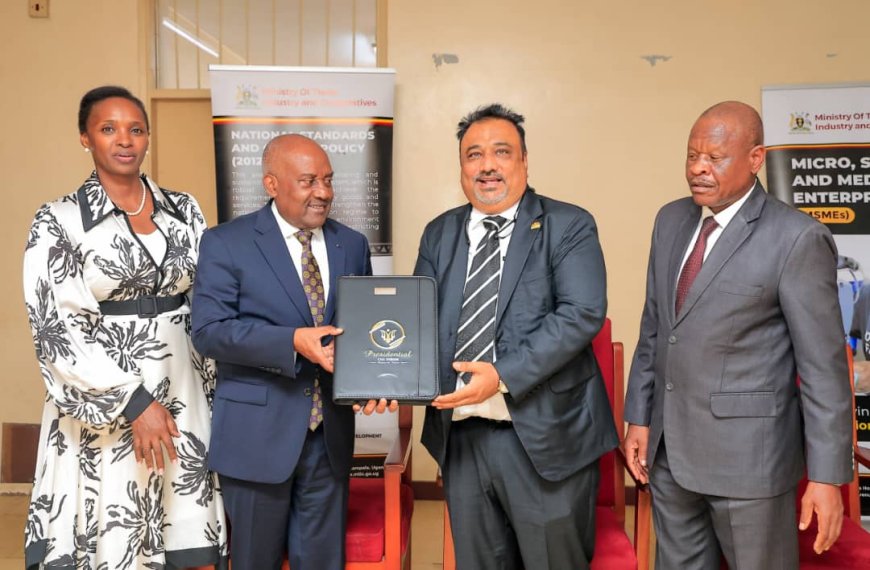


The Minister of Trade, Industry and Cooperatives Hon. Sanjay Tanna has held a meeting with members of Uganda Manufacturers (UMA) in a bid to strengthen the partnership between his ministry and UMA in promoting Uganda’s industrialization agenda. The high-level dialogue brought together both government and the private sector to tackle the pressing challenges faced by manufacturers and chat a clear path for industrial growth.
In a meeting that has taken place at the home of manufacturers in Lugogo, on behalf of UMA, Richard Mubiru, a board member and chairman of the Economic Business Policy Committee raised critical issues of concern to the manufacturers, including the need to revisit the Employment Act, specifically severance pay, alongside a review of excise duties, other taxes, and the 30% upfront deposit required by URA for Tax Tribunal appeals.
UMA called for a deliberate action to transition the informal sector into formal, promote decent employment, enforcement of association membership, and a structured industrial licensing framework.
In his remarks, Hon. Tanna declared that the Ministry's "first war" is data collection, with ongoing efforts to digitalize databases to drive evidence-based policy formulation and implementation. He advised manufacturers to adopt net metering to stabilize power costs and urged massive investment in agro-processing as a national duty.
The Minister told the manufacturers that they have a critical role to play in achieving Uganda’s Ten-Fold Growth Strategy under the National Development Plan IV which targets a 500 billion USD economy. He urged the manufacturers to align their investments with government’s four core pillars; Agro-industrialization, Tourism development, Mineral Development, and Science, Technology & Innovation.
He committed to work with the manufacturers to implement the ATMS, using digital systems to offer flexible compliance options, and conducting quarterly factory visits. On non-recyclable plastics, the Ministry is actively seeking sustainable solutions.
The line minister in charge of Industry Hon. David Bahati reiterated government's commitment to industrialization, highlighting that Uganda no longer imports industrial sugar, which is a major milestone for the country. He confirmed that industrial mapping is underway and licensing legislation is being finalized. With the industrial sector now contributing 27.4% to GDP and government steadfastly targeting the 5-cents-per-unit electricity tariff for factories, he closed by urging manufacturers to "work with us as your mother ministry."
The meeting underscored a shared commitment to systems, digitalized data, and direct engagement as the cornerstones of Uganda's industrialization agenda.